KIT has set itself the goal of strengthening the links between science and society. But what does that mean in everyday research work – and how can we check whether these links are actually having an impact?
When talking about “impact,” it is important to specify what kind of impact is meant and whether it can be observed empirically. PaFo provides an analytical tool for this purpose: We examine whether participation formats have an impact on research—and if so, how these changes can be traced, for example, in research agendas, institutional decisions, or the self-image of scientific organizations.

Citizen dialogues as a catalyst for questions and methods.
Meaning of impact
It only becomes visible when institutions are prepared to embrace new perspectives, tolerate irritations, and allow feedback processes.
Impact measurement makes it possible to understand:
- which topics generate social resonance—and which do not
- where trust is created or becomes fragile
- where new questions arise
- and where research processes are realigned (or remain unchanged)
Impact measurement thus reveals not only the possible effects of participation, but also its limitations and areas of tension.
Impact measurement as the basis for credible participation strategies.
Feedback in organizations
Possible effects may include:
- Impulses for socially relevant frameworks
- New topics or alternative questions
- Changed perspectives on research processes
- Disruption of existing routines or assumptions
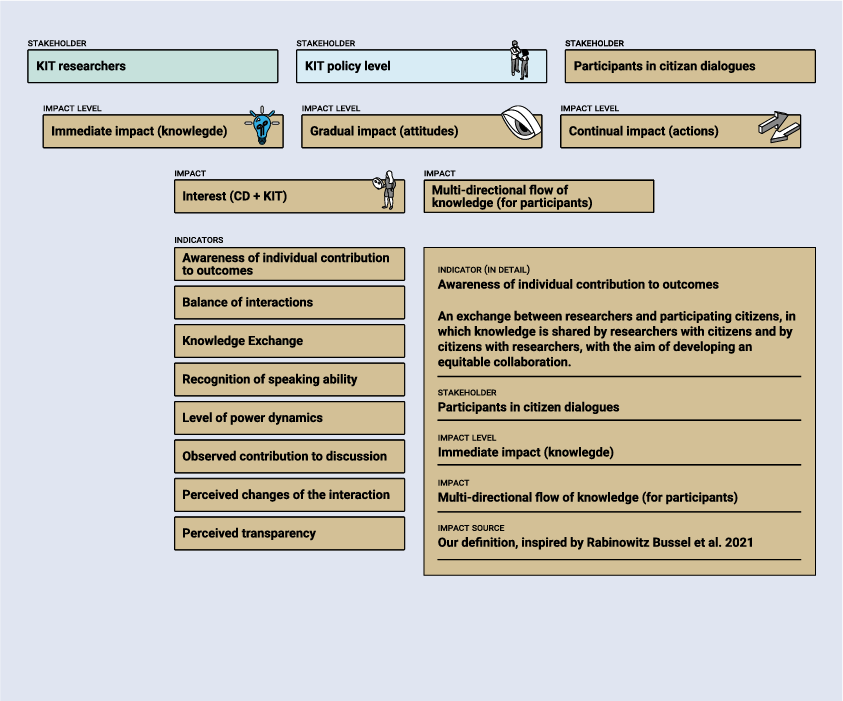
The impact matrix describes such relationships as comprehensible impact paths—without assuming that an impact will occur. It reveals whether participation influences research organizations, challenges them, or has no effect.
Science and Social Impact
PaFo combines the perspectives of science and society and helps to measure impact not only retrospectively, but also analytically from the outset.
Strategic relevance for KIT
Impact measurement supports priority setting, strategic decisions, and the further development of research priorities—without participation being considered a guarantee of impact.
Feedback processes
The matrix shows where participation leads to change, where contradictions arise, and where processes run counter to each other. It makes such frictions visible—not in order to resolve them, but to understand them scientifically.

Impact measurement as self-assessment
For KIT, this means that participation is not an add-on, but a form of institutional self-observation. Impact measurement makes it possible to understand how dialogues and participation formats affect research—or where no impact can be identified. It provides an empirical basis for funding applications, strategic development processes, and the goal of making research socially relevant and scientifically sound.